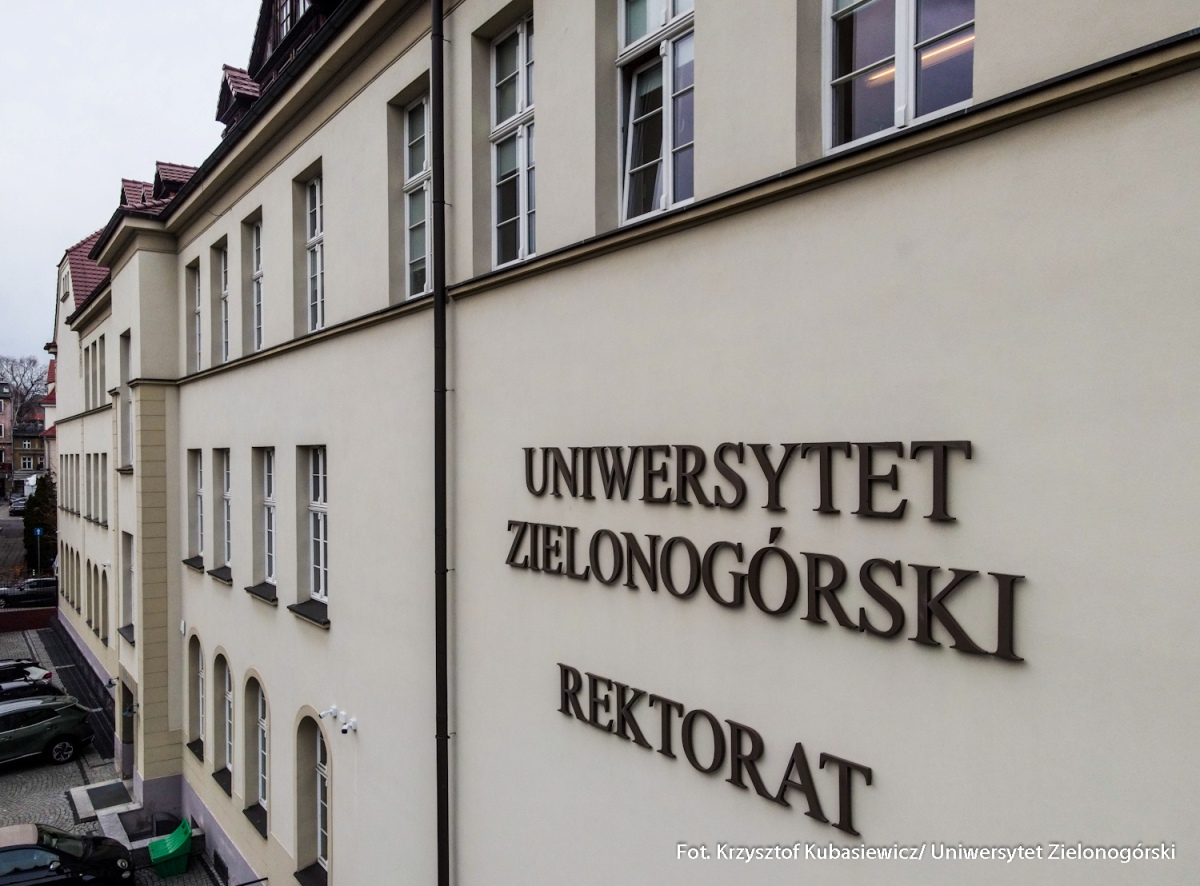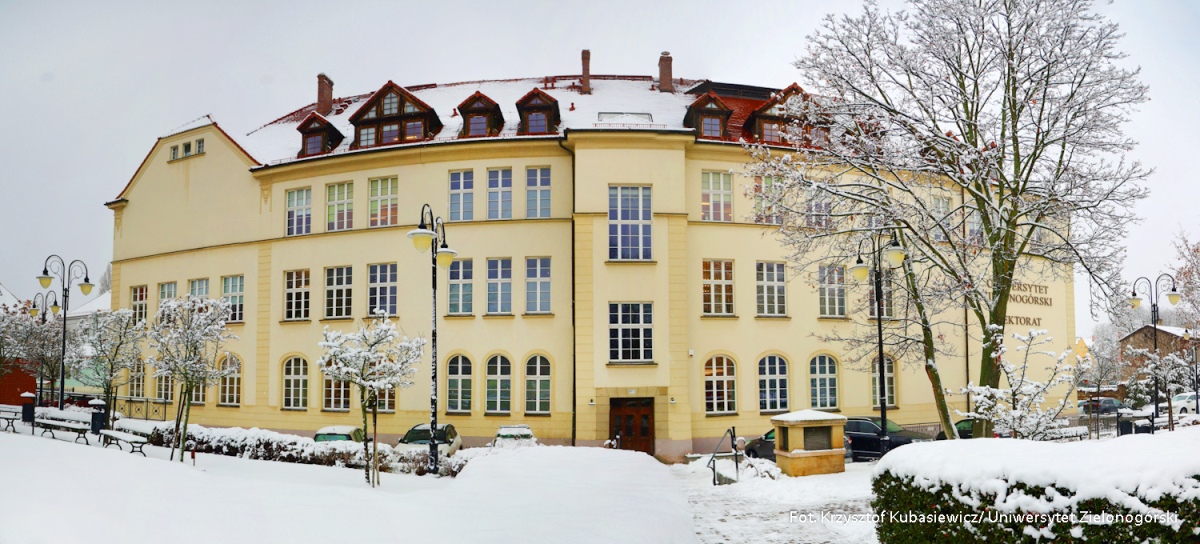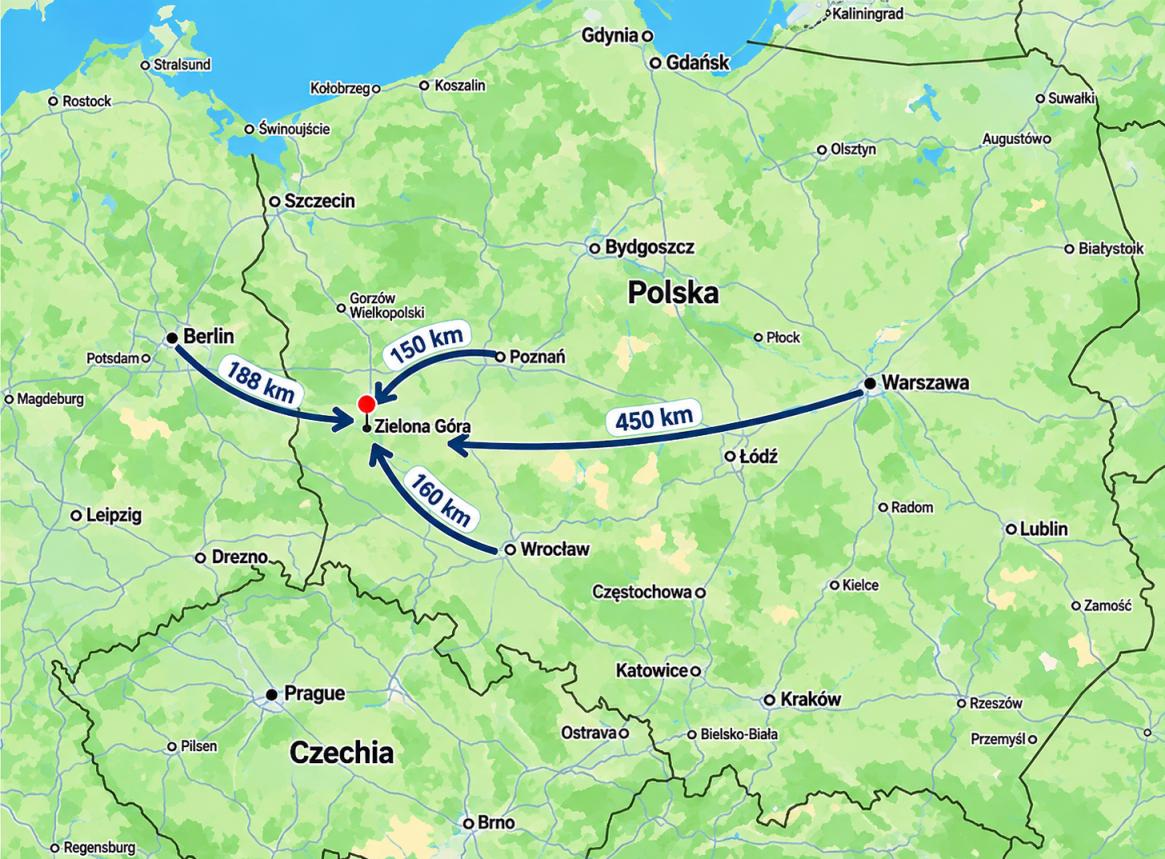
Located in the west of Poland, Zielona Góra is only 2 hours from Berlin, with great train connections to Poznań and Wrocław. The city, home to around 140,000 people, is surrounded by beautiful hills and forests, making it perfect for outdoor adventures. The name “Zielona Góra” means “Green Mountain,” and the city truly lives up to it!
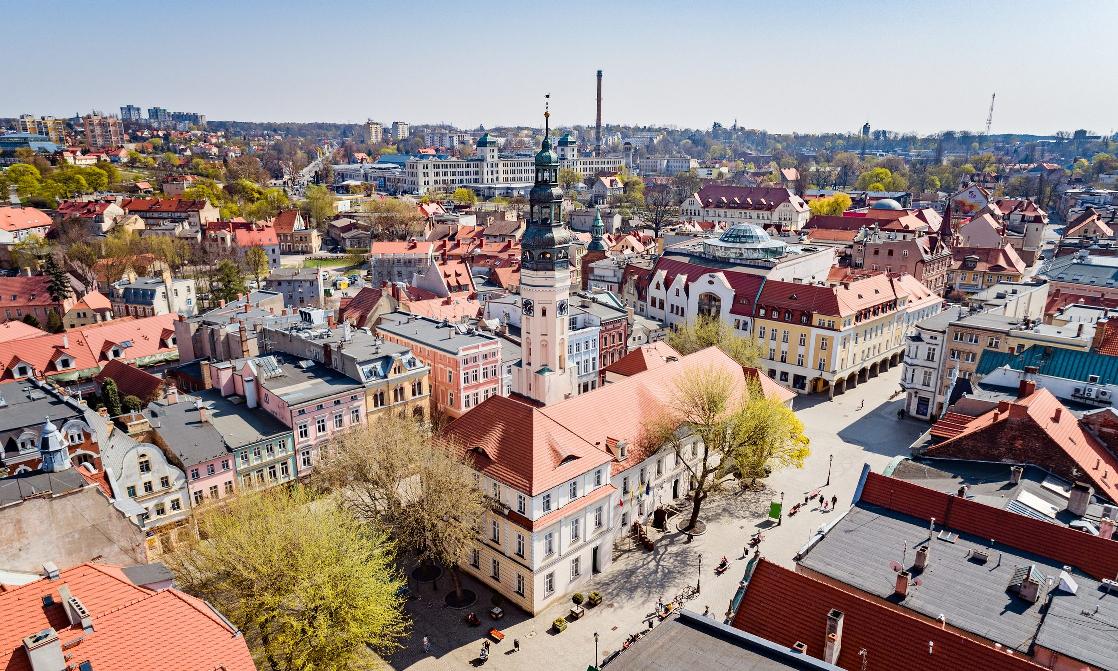
The charming pedestrian center is full of shops, cafes, and places to explore. Zielona Góra is famous for its long history of winemaking. Each September, the Winobranie Wine Festival fills the streets with music, parades, and plenty of local wine. The Lubusz Wine Centre, linked to the University, supports wine research and education.
The picturesque setting of Zielona Góra and its surroundings not only offers the opportunity to admire beautiful views but is also one of the factors contributing to grape cultivation in this region. According to oral tradition, the first vineyards were established here around 1150. However, the oldest documented record of local grapevine cultivation dates back to 1314. Since then, winemaking has experienced its ups and downs, but it has never ceased to be an important part of the city’s identity. Today, the region’s flagship attraction is a 35-hectare municipal vineyard—the largest in Poland—located right next to the Lubuskie Winemaking Center in Zaborze.
Traces of the city’s winemaking prowess can also be found in the country’s only Wine Museum, which is part of the Lubusz Region Museum. Visitors are also enchanted by “underground Zielona Góra”—the city’s wine cellars, which are unique in Poland and are increasingly used to promote winemaking. Local winemakers produce wines that are gaining recognition both at home and abroad. Local Riesling, Solaris, and Regent are regular fixtures on the tables of Zielona Góra residents.
The University of Zielona Góra is the biggest public academic institution in the Lubuskie province. Even though UZ is relatively young, Zielona Góra’s academic traditions date back to as far as the previous century. They began in 1965, when the Engineering College, transformed then into the Technical University of Zielona Góra, was established. In 1971, in turn, the Teacher-Training College was founded and in 1973 became the Tadeusz Kotarbiński Pedagogical College. The University of Zielona Góra was formed on 1st September 2001 by the merger of the schools in question. Additionally, on 1st September 2017 the Public Training College in Sulechów was incorporated into UZ.
Circa 10,000 people are studying here. Our university offers first-cycle (a bachelor’s degree) and second-cycle (a master’s degree) study programmes - both full-time and part-time ones, graduate programmes in 2 doctoral schools: the Doctoral School of Humanities and Social Sciences and the Doctoral School of Exact and Technical Sciences, as well as postgraduate programmes.
Currently, our university consists of 7 faculties:
There are also 29 institutes which cooperate with the faculties. At the faculties, students can choose from 70 fields of study in Polish and 13 ones in English and numerous specialities related to: humanities, social sciences, economics, natural sciences, medicine and health, technical and exact sciences, and arts. Thus, because of its broad scope of scientific disciplines on offer, the University of Zielona Góra belongs to the elite group of classical universities.
The University is conducting research in 24 scientific disciplines and is authorised to confer a postdoctoral degree and a doctoral degree in 23 scientific disciplines.
Within the institution of the University of Zielona Góra, the Research and Development Centres are operating.
The University of Zielona Góra is also a shareholder of the Karol Marcinkowski University Hospital in Zielona Góra Ltd. The hospital is one of the largest and most modern health care institutions in the Lubuskie province. It constitutes an educational and scientific base for our university’s students.
Thanks to European Union funding, the University of Zielona Góra has enriched its educational resources with, among other things, the modern University Library – the biggest research library in the province which serves not only students and employees of the university but also the residents of the city and the region.
The Botanical Garden operates within the Faculty of Biological Sciences. Along with the inception of UZ, the University Publishing House has been formed and each year published 130 publications on average, whereas as many as 40-50 of them have been fully edited.
The University of Zielona Góra has a well-developed educational base, laboratories and lecture halls. By constant changes, our university does its best to increasingly improve on its conditions and be up to date.
Our students develop their skills and pursue their hobbies in various scientific circles and student organisations. They can also do sport on many sports facilities (such as a gym or a sports hall).
What is more, the University of Zielona Góra has its own Big Band and flourishing academic media, i.e. Index Radio and a portal called www.wzielonej.pl. The graduates of this alma mater have been the “parents” of an association called Zielonogórskie Zagłębie Kabaretowe (the Zielona Góra Cabaret District) which is found to be the cradle of Polish cabaret.
The University of Zielona Góra is progressing dynamically and is open to people and new challenges. Due to its serious scientific potential and rich material base, the university is perceived as one of the main regional windows to Poland and the world.